
01Selling
Who can I sell my product to?
- In which restaurants or segments could my product make sense?
- Which menus and products does an ingredient appear in?
Food market intelligence
Discover which ingredients are used across food manufacturers, foodservice brands and restaurants — and understand how ingredients are used across the food industry through real market data.
Start with what you want to understand. Then choose the market you want to see it in.
Where do you want to explore it?
Product directionThis field is where plain-language questions will go next: Ask Food Intelligence.See the direction
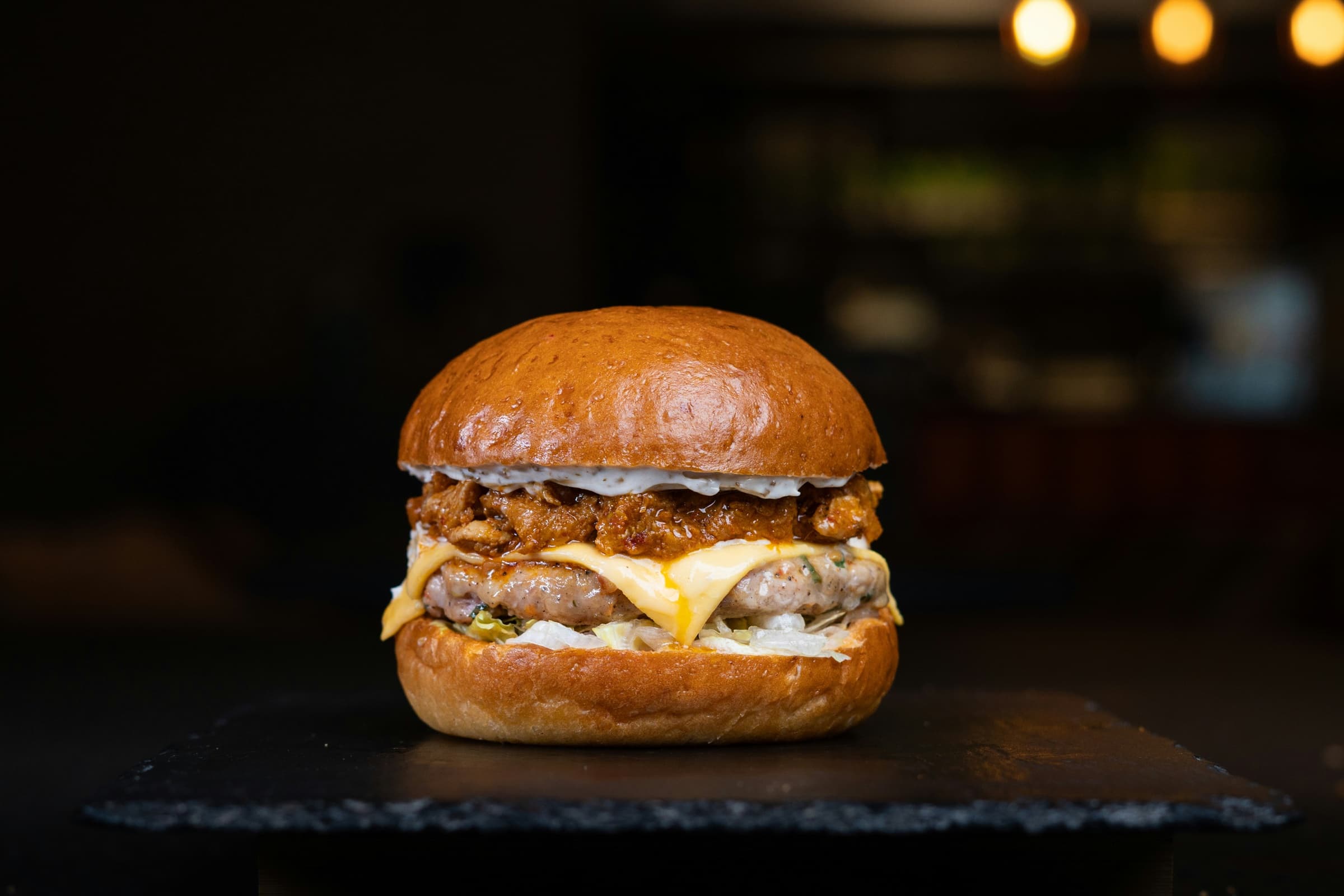
Editorial photo · not an analysis finding
Research sample
Avcılar, Istanbul · Burger menus
Analysis of 199 burger menu items across 11 restaurants in Avcılar.
In this sample, pickles appear in the burger menus of 10 of the 11 restaurants.
Source: Avcılar burger category study · delivery-platform listings, read by hand · a sample, not the whole market
02PRODUCT & INGREDIENT INTELLIGENCE
Explore which ingredients recur across protein bar products, how formulations differ, and how nutrition profiles vary across the analysed sample.
15-product pilot sample. Compiled from publicly available online product information; not verified from the packaging, and ingredient lists may be partial. Four products' values were converted from serving size to 100 g. Not a market census. Data sources →
Restaurant menus · packaged products · ingredientsFrom menus to products, and from products to ingredients, read the food market through a shared data language.
Editorial image · not an analysis finding · Photo: Polina Tankilevitch / Pexels
Most frequently observed ingredients
Product coverage, based on the recorded ingredient text
Product coverage = the number of analysed products containing the ingredient. Not usage quantity, market share or brand count.
Median
Range and median across the 15 products; four products' values are converted from serving size to 100 g. Each metric is read on its own scale, with no combined score.
03The problem
The answers sit on menus, product pages, shelves and catalogue lists. One question means stitching many sources together by hand.
01Selling
02Sourcing
03The market
Swipe to see the other questions
The answers exist. They are not in one place.
04Where the data comes from
From menus to shelves, from products to manufacturers, we bring scattered food data together in one intelligence network.
We separate what we know, what we infer, and what is not yet known.
Every claim retains its evidence basis.
01
What is offered, and where?
02
What do brands bring to market?
03
Who actually makes the product?
04
Category, assortment, price and claim signals, where the record has them.
05
Observed data, inference and sector knowledge stay separate.
Research coverage
Food Intelligence menu research corpus · 93,479 menu items across 11 cities · snapshot 10 Sep 2026
Evidence classes
01Observed
Seen directly in the source or dataset.
02Sectoral Knowledge
Context supported by industry knowledge.
03Inferred
An interpretation derived from the available evidence.
04Potential
A possible commercial fit or opportunity signal. Not buyer intent, a quote request or an order.
Data processing flowObservationStructuringMatchingInferenceCommercial reading
05The core chain
01
Where is the market activity?
02
What is on offer?
03
Which ingredients are used?
04
Who could supply it?
05
Where is the commercial connection?
Who can sell what to whom, and why?
Appearing on a menu does not mean a purchasing need. A potential match is not a confirmed buyer.
06Working views
Not four products. The same connected data, read with the question your job asks.
Commercial questions
01Selling
02Sourcing
03The market
04Research
Working views
Working view: Sell and source
Sourcing
Catalogue, MOQ and price information is not on every record. It is shown only where the source has it; what is missing stays unknown.
Working view: Procurement
Working view: Category
Working view: Analysis
The views open in the Dashboard in stages. Coverage varies by record and source, and no view presents information as present when the record does not have it.
07Product preview
The Dashboard's record logic, on real research.
Avcılar · 11 burger restaurants · 199 menu items read
The fields of a restaurant record
The table shows summary counts only; individual restaurants are not listed here.
Each record keeps brand, manufacturer, product and SKU information in separate fields. Until a manufacturer's identity is resolved, a candidate is not shown as a verified manufacturer.
The fields of a manufacturer record
At pilot stage: no public example record is published for this tab.
A potential match is not a confirmed buyer, and appearing on a menu does not mean purchase intent.
Preview. The Dashboard is not yet connected to this deployment.
08Featured intelligence
09Mirpua Intelligence + AI
Months of structured data, evidence, identity, menu, ingredient, product and manufacturer work will one day be reachable in plain language. That capability is not live today; what follows is a description of where we are heading.
Example question
Show cheddar use in burger restaurants in Ankara.
Not working yet.
The principle
The AI is not the source of truth. The database and the backend are.
The AI understands the question, calls the right tool, brings back an evidence-backed result, explains it and hands off to the Dashboard. It never has unrestricted, arbitrary SQL access to the database; it works only through permissioned tools and APIs.
10Membership and access
Start with open market evidence; then join, go deeper with Pro, or take a single report. Discover is open today, the rest are not open yet; tell us which one you need.
Swipe to see the other options
Scope, limits and prices have not been decided. Today no access needs an account or a payment.
The report purchase flow
Soon. Access will open only through an entitlement the server verifies; a parameter in the address bar or browser storage never opens anything.
An enterprise solution is not a membership tier; it is a separate conversation for specific needs.
11Frequently asked
The answers are written for the situation today. What is unknown is left unknown.
A layer of food-market analysis that connects restaurant menus, products, ingredients and manufacturers, separated by evidence class. The aim is to put scattered data into a form that can answer a commercial question.
From public restaurant and menu listings, product and retail observations, manufacturer information and structured research studies. Every published figure has its source on record.
No. An ingredient seen on a menu is not a purchase record or a current need. We do not offer information on purchase volume or intent.
The manufacturer area of analysis and the pilot work in the Dashboard are being prepared for this. We do not offer a verified supplier directory; candidates whose identity is unresolved are not shown as verified manufacturers.
No. This information is shown only where the source has it; what is missing stays unknown. We do not claim price, catalogue or MOQ coverage across all records.
Standard membership is planned as entry-level access and Pro as deeper, recurring access. Scope, limits and prices have not been decided and neither is open today; you can write to us for information.
Yes, that is the design: a report will be available on its own, without a membership. The payment flow is not open yet; today you can request report access. Access will open only through an entitlement the server verifies.
The AI capability is not live yet. By design it will query governed Food Intelligence data only through permissioned tools and APIs, and keep evidence and provenance in the answer. It will have no free SQL access to the database.
Menus are read from public listings with a fidelity-to-source rule. Ingredients are matched to menu items with a rule-based dictionary. In the Avcılar burger study the listings were extracted by hand.
Observed is what the source shows directly, such as a menu naming cheddar. Inferred is a relationship derived from what was observed. The two are never given the same label.
An opportunity is a connection between observed data, for example an ingredient appearing on many menus. It is a potential match, not a confirmed buyer or an existing commercial relationship. We do not offer an automated match score.
The published research snapshot covers 11 cities. The Avcılar burger study covers a single district. Coverage outside Türkiye is at pilot stage and varies by record.
The pilot work in the Dashboard includes candidate manufacturers from abroad for review. They are unverified candidates and are not listed by company name on the public site.
The website explains Food Intelligence, publishes research and provides access. The Dashboard is where you work with the data. The Dashboard is not yet connected to this deployment; until it is, a search is passed on but not run.
Research with Food Intelligence, discover the connections and reach the right opportunities faster.